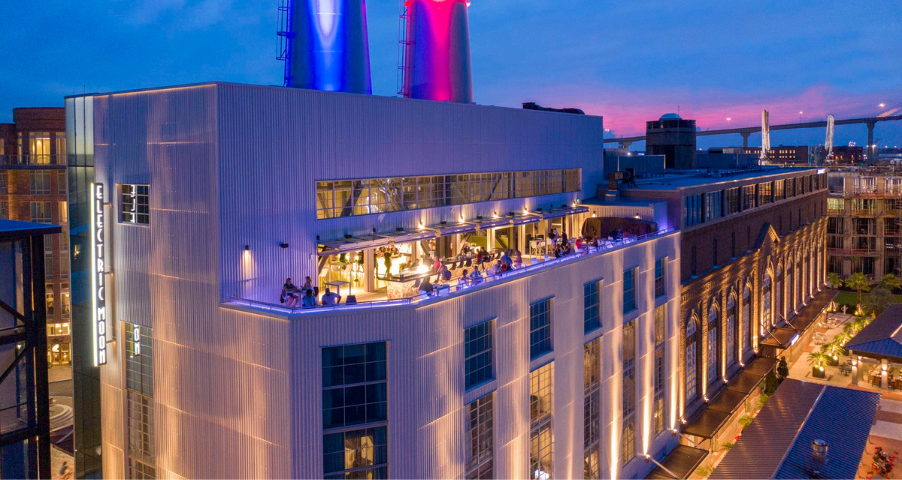
For years, exterior lighting was treated as a necessary scope item. It lit the parking lot, illuminated the path, and satisfied code requirements.
Today, that mindset is shifting.
Across healthcare campuses, mixed use developments, higher education, and corporate environments, outdoor lighting is being evaluated more strategically. Owners are looking beyond minimum light levels. Facilities teams are thinking long term. Design professionals are being asked to do more with exterior environments.
Commercial landscape lighting is no longer an afterthought. It is becoming a deliberate investment.
Here is what we are seeing in the market right now.
Outdoor Spaces Are Now Part of the Experience
Exterior environments are increasingly viewed as extensions of the building itself.
Courtyards, pedestrian corridors, entry sequences, and façade elements are receiving more design attention than they did even five years ago. Lighting plays a central role in that shift.
The conversation has evolved from “Is it bright enough?” to more thoughtful questions:
- Does this space feel comfortable after dark?
- Are we supporting wayfinding without overlighting?
- Does the façade lighting reinforce the architectural intent?
- Are we extending usable hours without driving unnecessary operating costs?
In healthcare, lighting contributes to patient and visitor comfort. On higher education campuses, it affects walkability and safety perception. In mixed use developments, it shapes how people gather and engage in the evening.
Experience is measurable now. It influences retention, leasing, and brand perception. Exterior lighting has a seat at that table.
Safety and Reliability Still Anchor Every Decision
While experience is gaining attention, safety remains foundational.
Many facilities teams are managing aging exterior systems that were installed ten to twenty years ago. Older HID fixtures often result in uneven light levels, increased maintenance demands, and higher energy use.
The current wave of upgrades is not simply about converting to LED. It is about improving overall performance:
- Better optical control and uniformity
- Reduced glare and light trespass
- Longer maintenance intervals
- Lower total cost of ownership
There is also a growing awareness around liability. Uneven pathways, poorly lit parking areas, or excessive glare can create exposure that owners would prefer to eliminate.
The projects we are seeing are thoughtful. They are focused on long-term reliability and predictability, not short-term fixes.
Controls and Smart Exterior Systems Are Expanding
Networked controls are moving beyond the building envelope.
Owners and facilities leaders are increasingly evaluating exterior lighting as part of their broader energy strategy. Zoned dimming after business hours, scheduling aligned with occupancy patterns, and integration with security systems are becoming more common.
For larger campuses, remote monitoring provides visibility that simply did not exist before.
These systems offer real value. They also require early coordination between electrical contractors, facilities teams, IT departments, and ownership.
When controls are layered in late, complexity increases. When they are addressed early, they protect both budget and design intent.
This is where a collaborative process makes a meaningful difference.
Sustainability and Compliance Are Shaping Design
Municipal ordinances continue to tighten around outdoor lighting.
Dark sky requirements, glare limitations, light trespass restrictions, BUG ratings, and warmer color temperature preferences are influencing fixture selection and layout decisions.
Landscape architects and design teams are navigating a narrow path between visual impact and compliance.
Photometrics are no longer a formality. They are a safeguard. Running calculations early helps protect the design vision while ensuring regulatory alignment.
Exterior lighting decisions carry environmental responsibility. They also carry design consequence.
Budget Clarity and Supply Chain Awareness Still Matter
Exterior luminaires often rely on global supply chains. Lead times and pricing can shift, especially on campus scale projects.
Sophisticated owners are asking practical questions:
- Should upgrades be phased?
- Can fixture families be standardized across properties?
- Are there alternatives that maintain distribution and performance?
- What are realistic lead times?
Facilities teams are thinking about replacement cycles and long-term serviceability.
The key is transparency. Proactive planning during design and preconstruction helps avoid costly substitutions or delays later in the project.
Where We Are Seeing Activity
From what we are seeing in the field, activity remains strong in several segments:
Healthcare campuses are upgrading exterior systems to improve patient navigation and safety.
Higher education institutions are investing in walkability and campus identity.
Mixed use developments are activating outdoor plazas and gathering areas.
Corporate campuses are reinvesting in site experience as part of broader repositioning efforts.
Deferred maintenance programs are resurfacing after prior budget pauses.
These are not speculative trends. They reflect practical priorities that owners and facilities teams are actively managing.
Exterior Lighting Is Infrastructure With Design Impact
Commercial landscape lighting now sits at the intersection of safety, operations, compliance, sustainability, and brand experience.
It influences how a property performs and how it is perceived.
At Ardd + Winter, we believe exterior lighting strategy works best when it is addressed early. Assessing the site conditions, aligning design intent, evaluating budget during preconstruction, and coordinating controls before installation all protect the outcome.
Lighting and controls do not have to be complicated. With the right collaborative process and the right people at the table, they become clear and manageable.
If you are evaluating an exterior upgrade or planning a new development, we welcome the conversation. Thoughtful planning today can prevent friction tomorrow and ensure your site performs as intended for years to come.