
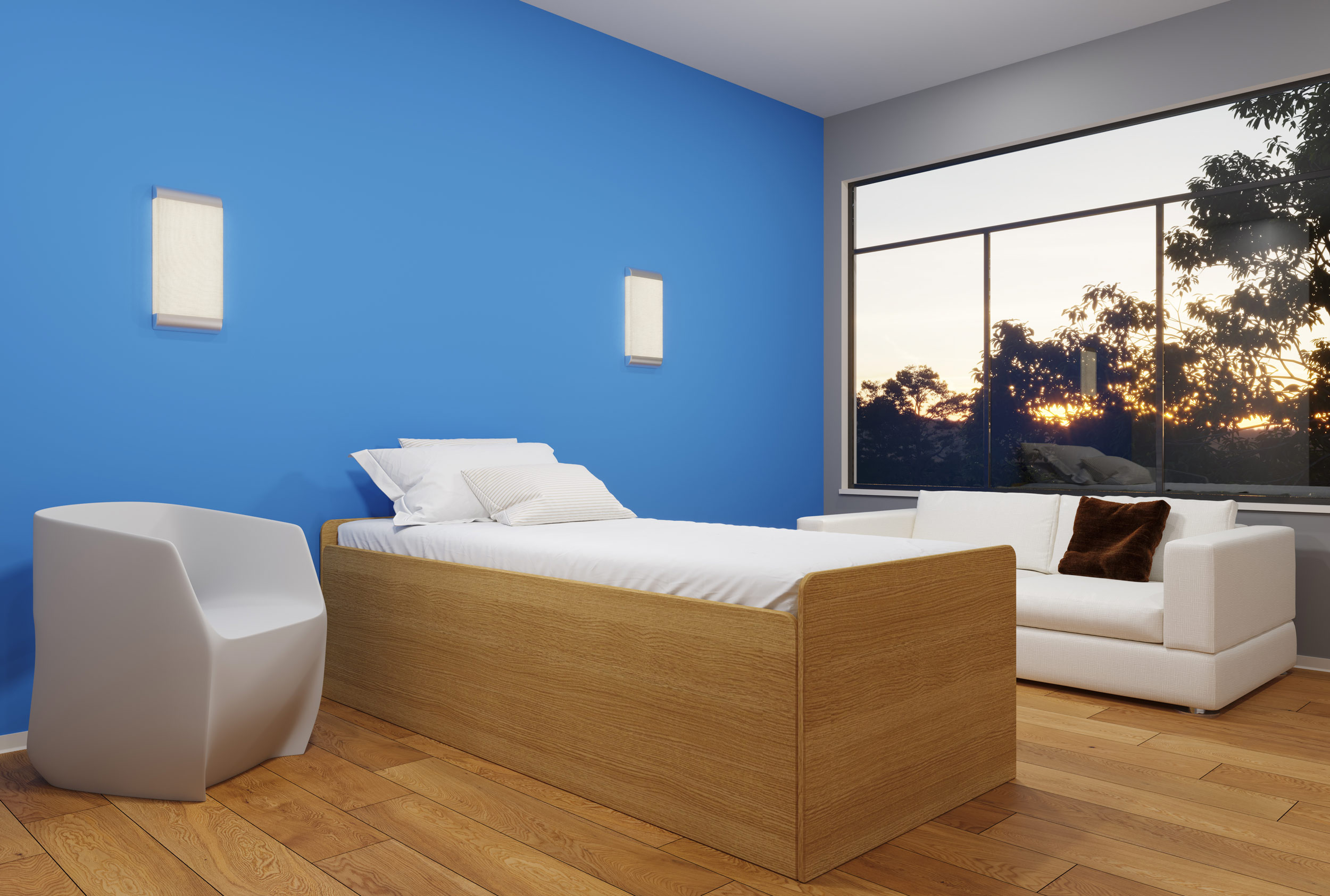
Behavioral health is moving to the forefront of the care journey. From emergency department (ED) intake and inpatient floors to imaging and outpatient clinics, patients with behavioral health needs progress through public areas and specialized rooms rather than isolated units at the end of a corridor. That shift asks lighting to do more: set a calm, welcoming tone, support therapeutic goals, meet safety requirements, and still deliver the technical performance clinicians rely on. Recent Facility Guidelines Institute (FGI) 2022 updates reflect this reality by extending behavioral‑health‑informed design beyond inpatient rooms into places like ED waiting and hospital public zones.
No matter which lighting agent you partner with, the challenge remains the same: design lighting as a single, connected platform that supports today’s behavioral health strategies without gaps, last‑minute substitutions, or mismatched visual language.
At Ardd + Winter, we’ve always focused on helping design teams build lighting schedules that work as one integrated system from the front door all the way to specialized clinical and diagnostic environments. We continue to expand our lines while manufacturers we represent continue to expand their offerings to match that need: creating cohesive families across architectural, behavioral, exam, OR, and specialty spaces; elevating cleanability; and strengthening performance where healthcare environments demand it.
Front of House: Hospitality Cues with Clinical Intent
Goal: Create a welcoming, de‑institutionalized first impression while keeping wayfinding and caregiver visibility clear.
Front‑of‑house spaces carry a lot of weight. They’re the first moments a patient or family member sees, and for behavioral health populations in particular, those first impressions can help reduce agitation and build trust. A layered mix of ambient and accent lighting supports orientation and reduces visual fatigue for staff and guests. While daylight is always ideal, most interiors rely on electric light to provide comfort, consistency, and reliability throughout the day.
Some practical design moves include:
- Layered ambient and accent lighting with controlled glare and low‑flicker drivers to reduce discomfort in sensitive populations.
- Warm‑biased scenes in public areas, paired with tunable white for flexibility without changing fixture families.
- Consistent architectural language from lobby to patient areas using families that offer both standard and ligature‑resistant versions.
When a project transitions from lobby to behavioral spaces, maintaining that continuity matters. Your lighting agent can help you choose families that look unified across risk zones even when construction, mounting, or hardware must change behind the scenes.
Patient Care: Safety, Healing, and Clinical Performance
Behavioral health patient areas must feel therapeutic and safe while still supporting clinical tasks. Today’s high‑abuse, ligature‑resistant luminaires blend into modern healthcare interiors far more easily than in years past with many offering:
- IK10 impact ratings, tested to withstand significant force
- Sealed, tamper‑resistant construction
- IP65–66 ingress protection for cleaning protocols and environmental demands
These aren’t the institutional boxes of the past. Manufacturers now pair resilience with architectural form, so patient areas feel warm and familiar rather than punitive.
Ligature‑resistant construction, including smooth geometries, countersunk fasteners, and sealed lenses, should match the room’s supervision level. Lighting quality matters just as much as the hardware: tunable white strategies with warm daytime bias, low‑flicker drivers, and ultra‑low night levels support rest and reduce agitation. The evidence around artificial circadian systems is still evolving, so steady fundamentals like optics, flicker, spectrum, and controls still remain the most reliable path.
In exam and treatment areas, luminaires should meet IES RP‑29 targets for vertical and horizontal illuminance, with high uniformity and controlled glare. Tools such as the IES Illuminance Selector can help verify criteria during design and documentation.
Emergency departments and crisis units add an extra layer. FGI 2022 guidance expands anti‑ligature expectations into ED triage, public toilets, and waiting areas. Engaging clinical teams early helps balance safety with user experience, applying ligature‑resistant models in low‑supervision rooms and architectural families in monitored zones to avoid an institutional feel.
Back of House & Specialty: Cleanability, Ratings, and Technical Constraints
Behind the scenes, lighting becomes highly technical. Operating rooms, trauma bays, procedure rooms, and clean environments demand fixtures that withstand heavy use, aggressive cleaning, and higher environmental requirements.
A few important distinctions:
- UL damp/wet listings identify the intended use environment.
- IP ratings (IEC 60529) indicate the tested resistance to dust, moisture, or water spray.
An IP66 luminaire, for example, is tested to withstand powerful water jets that are useful in clinical areas where wash‑downs are routine. Many healthcare fixtures carry both UL and IP designations, but the ratings serve different purposes and shouldn’t be assumed equivalent.
MRI suites require an entirely different approach: non‑ferrous construction, remote drivers, and designs that minimize electromagnetic interference. Some luminaires incorporate back‑lit graphics or sky images to reduce patient anxiety, which is an increasingly common strategy in MRI environments.
Resilience and emergency response also matter. UL 924 emergency fixtures and quick‑transfer inverters help maintain illumination during outages, especially important in behavioral health areas where sudden darkness can increase stress or confusion.
When projects cross multiple risk zones, curating the right families allows you to keep the visual language consistent while stepping up construction and performance only where necessary.
Evidence‑Informed, People‑Centered
Light shapes how people feel, heal, and navigate clinical environments. While research continues to evolve, particularly around circadian lighting, evidence consistently supports fundamentals: correct illuminance, appropriate spectrum, low flicker, glare control, and lighting that aligns with clinical workflow. Getting these basics right often matters more than layering on complex automated systems.
Why an Integrated Platform Matters
Behavioral health no longer functions as a single unit. More and more, it’s woven through the entire campus. That’s why teams benefit from an integrated manufacturer platform that spans front of house → patient care → back of house without patchwork compromises or last‑minute substitutions. Avoiding gaps keeps projects on schedule, protects budgets, and delivers a consistent patient and staff experience from the lobby to the MRI.
Ardd + Winter partners with leading healthcare lines to build that continuum of decorative and architectural families for public spaces, ligature‑resistant and high‑abuse luminaires for behavioral environments, exam/OR luminaires that meet IES and environmental ratings, and MRI‑specific non‑ferrous solutions.
Our role is simple: help you build a cohesive, code‑aligned lighting schedule that follows the patient journey from the front door to the most technical room in the building while looking like a healing environment at every step.
Our Healthcare & Behavioral Health Manufacturer Partners
We represent a unified portfolio capable of supporting every layer of healthcare from public‑facing spaces to highly technical surgical areas and secure behavioral environments:
- Certolux (Leviton) – High‑performance healthcare and behavioral health luminaires
- Fail‑Safe (Cooper Lighting Solutions) – OR, clean‑room, exam, and specialized medical fixtures
- Focal Point – Select exam and healthcare lighting solutions
- Sky Factory – Biophilic wall and ceiling system for healthcare spaces
- Visa Lighting – Decorative and architectural patient‑care luminaires, including behavioral health models
Explore our full line cards based on your location here: https://awlights.com/line-cards/
Reach out to Ardd + Winter specialist: Winfield Littleton at winfieldl@awlights.com to discuss your healthcare lighting needs


